
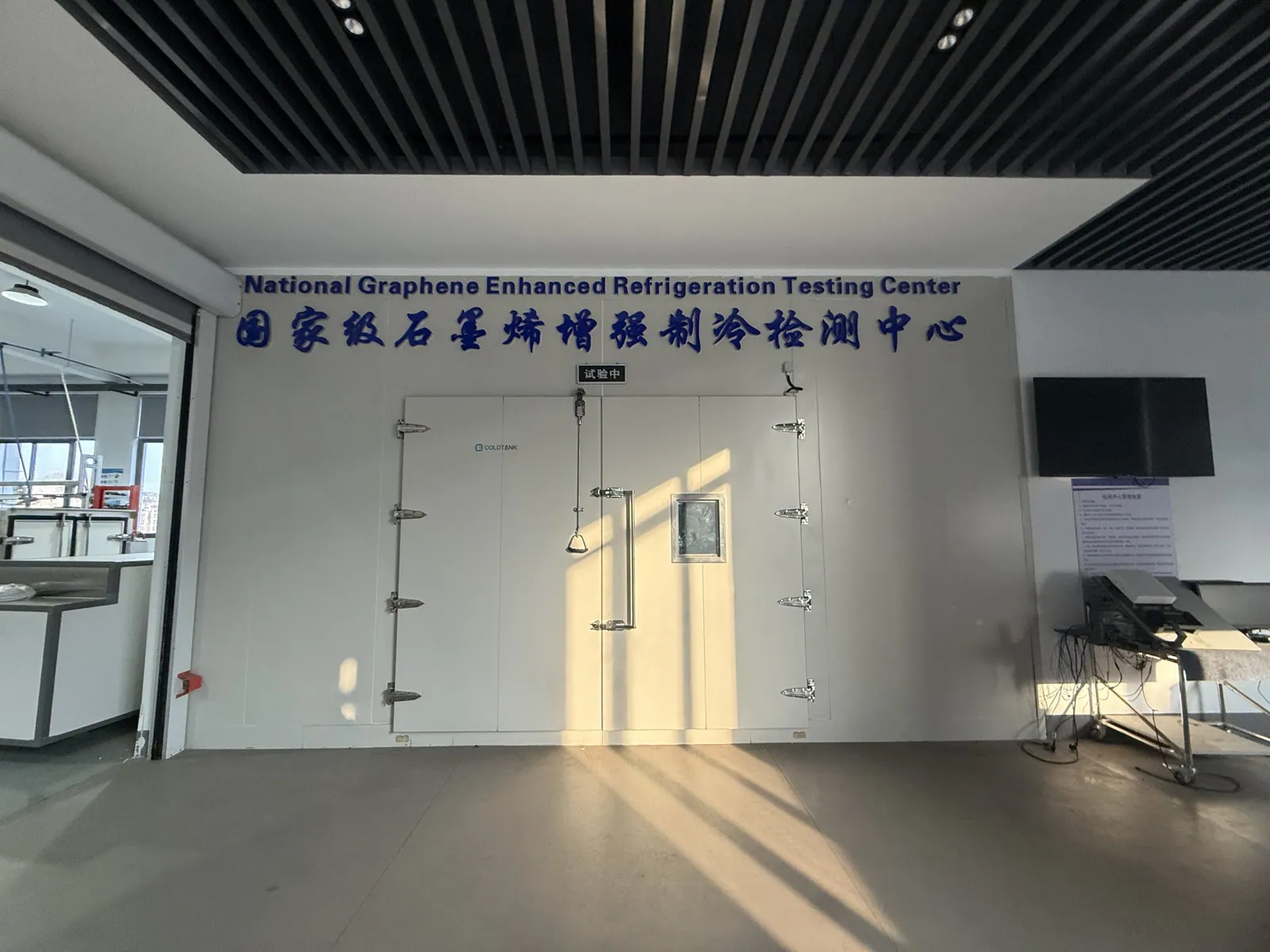
Three stages of testing
A cold chain box can fail in three ways: a refrigerant leak, a refrigeration unit that does not deliver its capacity, or a body that lets in too much heat. Our tests are arranged to catch each one as early as possible, when it is cheapest to fix.
| Stage | What is tested | Coverage |
|---|---|---|
| 1. Components | Each heat exchanger coil is pressurized to 3.8 MPa and checked for leaks before it is built into a refrigeration unit | Every coil |
| 2. Performance test | The refrigeration unit's cooling and the body's insulation, after the unit is installed in its compartment | Every box |
| 3. Aging run | The finished box runs for 12 hours before release, to expose early failures of compressors, fans, controls and joints | Every box |
| Engineering records | Pull-down and hold tests logged every minute, as shown below | Test units |
For development work, the laboratory also uses the air enthalpy difference method. It measures the temperature and humidity of the air entering and leaving the evaporator together with the airflow, and calculates cooling capacity from the change in the air's enthalpy. The same facility can simulate high temperature and high humidity, and is used to quantify cooling rate, temperature distribution in the cabinet, energy consumption and the heat leak through the insulation.
The pull-down test
A pull-down test measures how fast an empty, closed cabinet cools from room temperature. It is the clearest single measure of whether the refrigeration unit and the body work together. The two runs below were logged on an LMS980 with a set point of −25 °C.
| Run | Start | 0 °C | −10 °C | −18 °C | −25 °C | Lowest |
|---|---|---|---|---|---|---|
| A, 14 Aug 2026 | +29.5 °C | 16 min | 30 min | 49 min | 79 min | −30.6 °C |
| B, 15 Aug 2026 | +24.3 °C | 13 min | 25 min | 41 min | 65 min | −30.7 °C |
The full curves are on our certifications and testing page.
Why the last few degrees take longest
Dividing each step by the time it took gives the cooling rate at each stage:
| Stage | Run A | Run B |
|---|---|---|
| Start to 0 °C | 1.84 K/min | 1.87 K/min |
| 0 to −10 °C | 0.71 K/min | 0.83 K/min |
| −10 to −18 °C | 0.42 K/min | 0.50 K/min |
| −18 to −25 °C | 0.23 K/min | 0.29 K/min |
The rate falls by a factor of about seven between the first and the last stage. Two effects add up. As the cabinet gets colder, the difference between the cabinet air and the evaporator shrinks, so each square meter of coil moves less heat. At the same time, the difference between the cold cabinet and the warm room grows, so more heat leaks in through the walls. A refrigeration unit that looks strong at +20 °C can still struggle below −18 °C, which is why a quoted pull-down figure should always state the end temperature.
What a warmer start costs
Run A started 5.2 K warmer than run B. It reached −18 °C 8 minutes later and −25 °C 14 minutes later, and it was slower in every stage, not only at the start, because the room around it was also warmer. On a hot loading dock in summer, plan for the longer figure.
The hold test
After pull-down, the door stayed closed for 133 minutes. The mean cabinet temperature was −29.5 °C, between −30.1 °C and −28.0 °C, a band of 2.1 K. The control let the cabinet settle a few degrees below the −25 °C set point, so the goods stay on the safe side of a −25 °C limit.
How the data were measured
- Unit: LMS980 mobile cold chain box, set point −25 °C, empty, door closed.
- Instrument: Elitech RC-4 data logger with one probe, accuracy ±0.5 °C from −20 °C to +40 °C and ±1.0 °C outside that range, logging every minute.
- Room: 22.5 to 31 °C, not controlled.
- Status: in-house engineering record. The laboratory is not accredited by CNAS or a similar body.
We publish these conditions because a pull-down figure is meaningless without them. A one-probe reading gives the air temperature at one point; product temperature in a loaded cabinet will lag behind it.
From test data to a delivery plan
Use the test figures as a best case and adjust for real conditions:
- Pre-cool the box. An empty box from +24 °C needs about 41 minutes to reach −18 °C. Start it before loading, not at the dock door.
- Load product at its target temperature. The unit can pull warm product down, but much more slowly than an empty cabinet, because the product has far more thermal mass than air.
- Count door openings. Each opening lets warm air in. Use the side door for picking so the rear door stays shut.
- Plan battery time with margin. With the 48 V / 100 Ah lithium battery at 35 °C ambient, the LMS980 runs about 7 hours at −18 °C and 9 to 10 hours at +4 °C. The battery's nominal energy is 4.8 kWh, which implies an average draw of roughly 690 W at −18 °C and 480 to 530 W at +4 °C. These are rough figures from nominal capacity, but they show why a frozen route needs about a third more energy than a chilled one.
Key ratings of the tested unit
| Volume and payload | 980 L, 450–500 kg |
|---|---|
| Temperature range | −25 °C to +10 °C |
| Rated pull-down | −18 °C in about 43 min, empty cabinet; the logged runs above took 41 and 49 min depending on start temperature |
| Rated cooling capacity | 2200 W |
| Power consumption | 800 W |
| Refrigerant and charge | R513A, 900 g |
| Compressor | Brushless DC on a DC 48 V system |
| Safety report | Intertek CE-LVD No. 2607B0999SHA-001 (type designation LMS22-850W) |
What you can ask us for
With an order we can supply the data-logger records for the boxes you buy, the Intertek safety report, and the test conditions in writing. Under the 18-month warranty we send replacement parts and guide repairs by video call, and a full container order ships with two spare refrigeration units.
Safety is a separate question. Cooling data say nothing about electrical safety. For that, read what IEC 60335-2-24 tests and what the CE-LVD report proves.