
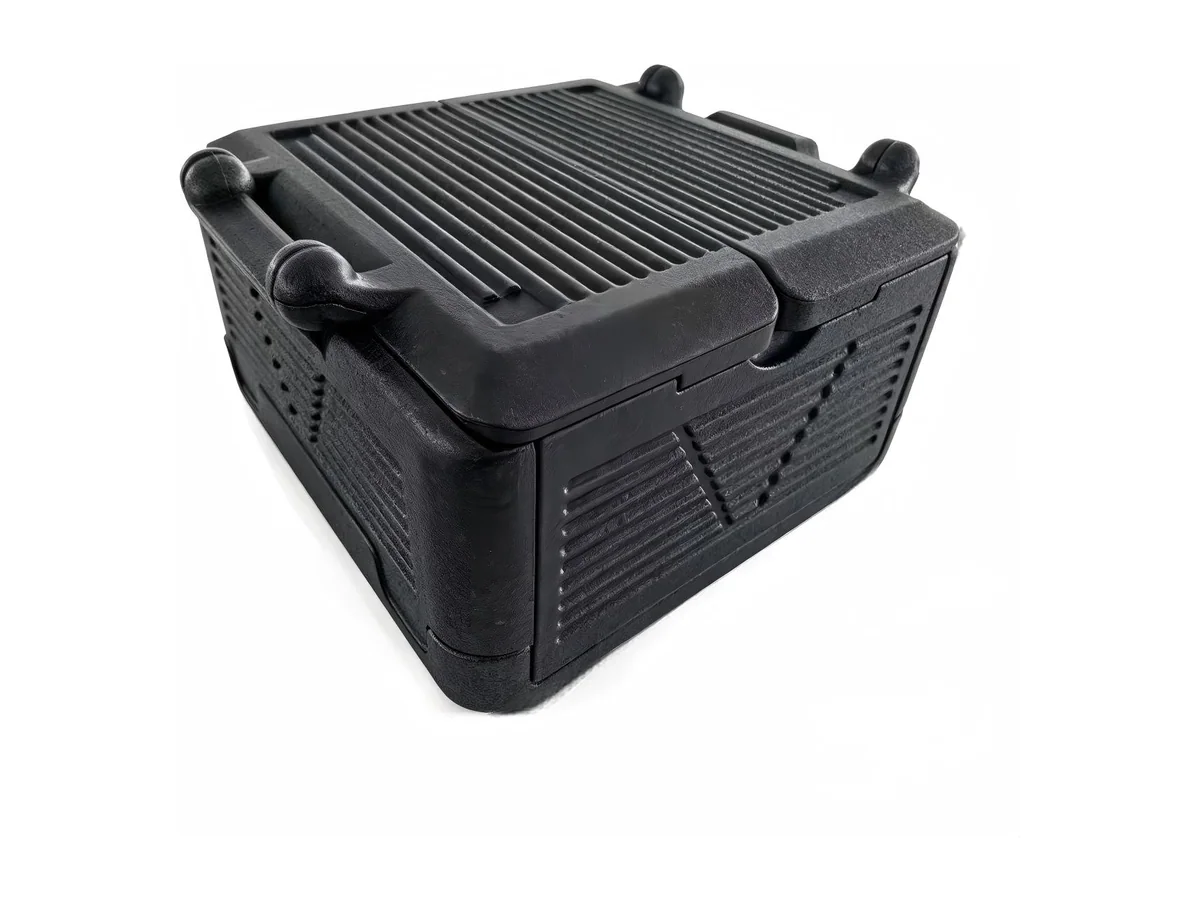
What was tested, and by whom
| Item | Entry in report No. SHAH0192717601 |
|---|---|
| Laboratory | Intertek Testing Services Wuxi Ltd.; asbestos test by Intertek Testing Services Ltd., Shanghai |
| Applicant | Wuxi Hi-Tec Environmental Material Co., Ltd., our EPP material supplier |
| Sample | Black EPP |
| Sample received | 9 February 2026 |
| Testing period | 9 February to 2 March 2026 |
| Report date | 2 March 2026, 24 pages |
| Conclusions | RoHS 2011/65/EU and (EU) 2015/863: Pass. REACH Article 33(1): Meets requirement |
The sample is the raw material, not a finished box, and the applicant is the material maker, not Lemosun. That is normal practice: chemical restrictions are controlled at the material stage, and one material report covers every product molded from it. It also sets the limits of the report, which we come back to at the end.
Test 1: the ten RoHS substances
RoHS restricts ten substances in electrical and electronic equipment. Every one was below the laboratory's reporting limit, which is far below the legal limit.
| Substance | RoHS limit | Reporting limit | Method | Result |
|---|---|---|---|---|
| Cadmium (Cd) | 100 mg/kg | 2 mg/kg | IEC 62321-5:2013, ICP-OES | Not detected |
| Lead (Pb) | 1000 mg/kg | 2 mg/kg | IEC 62321-5:2013, ICP-OES | Not detected |
| Mercury (Hg) | 1000 mg/kg | 2 mg/kg | IEC 62321-4:2013 + Amd 1:2017, ICP-OES | Not detected |
| Hexavalent chromium | 1000 mg/kg | 10 mg/kg | IEC 62321-7-2:2017, UV-VIS | Not detected |
| PBBs (10 congeners) | 1000 mg/kg | 5 mg/kg | IEC 62321-6:2015, GC-MS | Not detected |
| PBDEs (10 congeners) | 1000 mg/kg | 5 mg/kg | IEC 62321-6:2015, GC-MS | Not detected |
| DEHP, BBP, DBP, DIBP | 1000 mg/kg each | 100 mg/kg | IEC 62321-8:2017, GC-MS | Not detected |
Strictly, RoHS applies to electrical and electronic equipment, and an EPP box is not one. Buyers still ask for it because it is a well-known benchmark for heavy metals and brominated flame retardants, and because EPP is also used inside powered products such as our cold chain boxes.
Test 2: 255 REACH substances of very high concern
The laboratory screened all 253 substances on the EU Candidate List up to the 36th update (February 2026), plus two substances proposed at the time: resorcinol and 4,4'-methylenediphenol (bisphenol F). The reporting limit was 0.010 % by weight.
Two hundred and fifty-four were not detected. One was found:
| Substance | CAS No. | Added to the Candidate List | Result | Threshold |
|---|---|---|---|---|
| Triphenyl phosphate (TPhP) | 115-86-6 | November 2024 (32nd update) | 0.061 % w/w | 0.1 % w/w |
What 0.061 % means in practice
TPhP is used in plastics as a flame retardant and plasticizer. At 0.061 % it is at 61 % of the threshold, so it is legal and creates no duty to inform, but it is not zero, and a good supplier should say so instead of writing "SVHC-free".
To make the number concrete: 0.061 % is 610 mg per kilogram. Our largest folding box, the LMSZDBWXL, weighs 1.25 kg. If all of that weight were this material, it would contain about 0.76 g of TPhP.
Why 0.1 % is the line
The report summarizes the REACH duties that start at 0.1 % by weight in an article:
- Article 33(1): a supplier must give the recipient enough information to use the article safely, at least the name of the substance.
- Article 33(2): on request, a consumer must receive the same information within 45 days.
- Article 7(2): the producer or importer must notify ECHA if the substance is also present at more than 1 tonne per year.
- Waste Framework Directive: since 5 January 2021, the article must also be notified to ECHA's SCIP database.
Below 0.1 %, none of these duties apply. An article meets Article 33(1) by default.
The Candidate List grows twice a year. This report covers the list up to February 2026. Substances added later are not covered. For a large order, ask for the date of the latest screening.
Test 3: halogens
Fluorine, chlorine, bromine and iodine were each below 50 ppm, tested by combustion in an oxygen bomb and ion chromatography to BS EN 14582:2016. Many "halogen-free" definitions used in industry set limits of 900 ppm for chlorine or bromine and 1500 ppm for both together, so this result sits far below them. Halogen content matters at the end of life: halogenated plastics can release corrosive and toxic gases when burned.
Test 4: asbestos
Negative for actinolite, amosite, crocidolite, tremolite, anthophyllite and chrysotile, by microscopy with dispersion staining to AS 5370:2024 + Amd 1:2025, with an estimated detection limit below 0.01 %. The method is Australian. Australia applies a strict border ban on asbestos, so importers there are often asked for this test even on plastics.
EPP compared with EPS
EPP (expanded polypropylene) and EPS (expanded polystyrene) look similar but behave differently. EPP bends and recovers where EPS cracks, which is why an EPP box can be folded, washed and reused. Our EPP boxes are rated from −40 °C to +110 °C and for more than 500 reuse cycles. The report also screened for hexabromocyclododecane (HBCDD), a flame retardant historically used in polystyrene foam and on the Candidate List since 2008; it was not detected.
What the folding design adds
| Model | Volume | Weight | Height open | Height folded | Space saved | Per 40HQ, folded |
|---|---|---|---|---|---|---|
| LMSZDBWXS | 15 L | 0.75 kg | 220 mm | 100 mm | 55 % | 4200 |
| LMSZDBWXM | 20 L | 0.8 kg | 260 mm | 100 mm | 62 % | 3000 |
| LMSZDBWXL | 25 L | 1.25 kg | 265 mm | 100 mm | 62 % | 2140 |
The folded height is the package height in our packing list. Folding cuts return-trip and storage volume by more than half, which matters as much as the material in a reusable delivery system.
What the report does not prove
- It is not a food-contact test. Food-contact compliance is shown by migration testing: in the EU under Regulation (EC) No 1935/2004 and Regulation (EU) No 10/2011, in the US under FDA 21 CFR, for polypropylene §177.1520. This report contains no migration tests. If your goods touch the box directly, ask for food-contact evidence or use a liner.
- It covers the material, not the finished box. Printed logos, labels, coatings or hardware added later are not included.
- It is a single sample. It shows what the material was in February 2026. Batch consistency comes from the supplier's process control and from repeat testing.
Questions to ask any EPP box supplier
- Who made the material, and is the report in that supplier's name or a third party's?
- Which Candidate List update does the SVHC screening cover?
- Was anything detected, and at what level? "Pass" alone is not enough.
- Is there a separate food-contact migration report, and under which regulation?
Ask for the report. We send Intertek report No. SHAH0192717601 on request. Product details are on the EPP folding insulated boxes page, and all our documents are listed on the certifications page.