
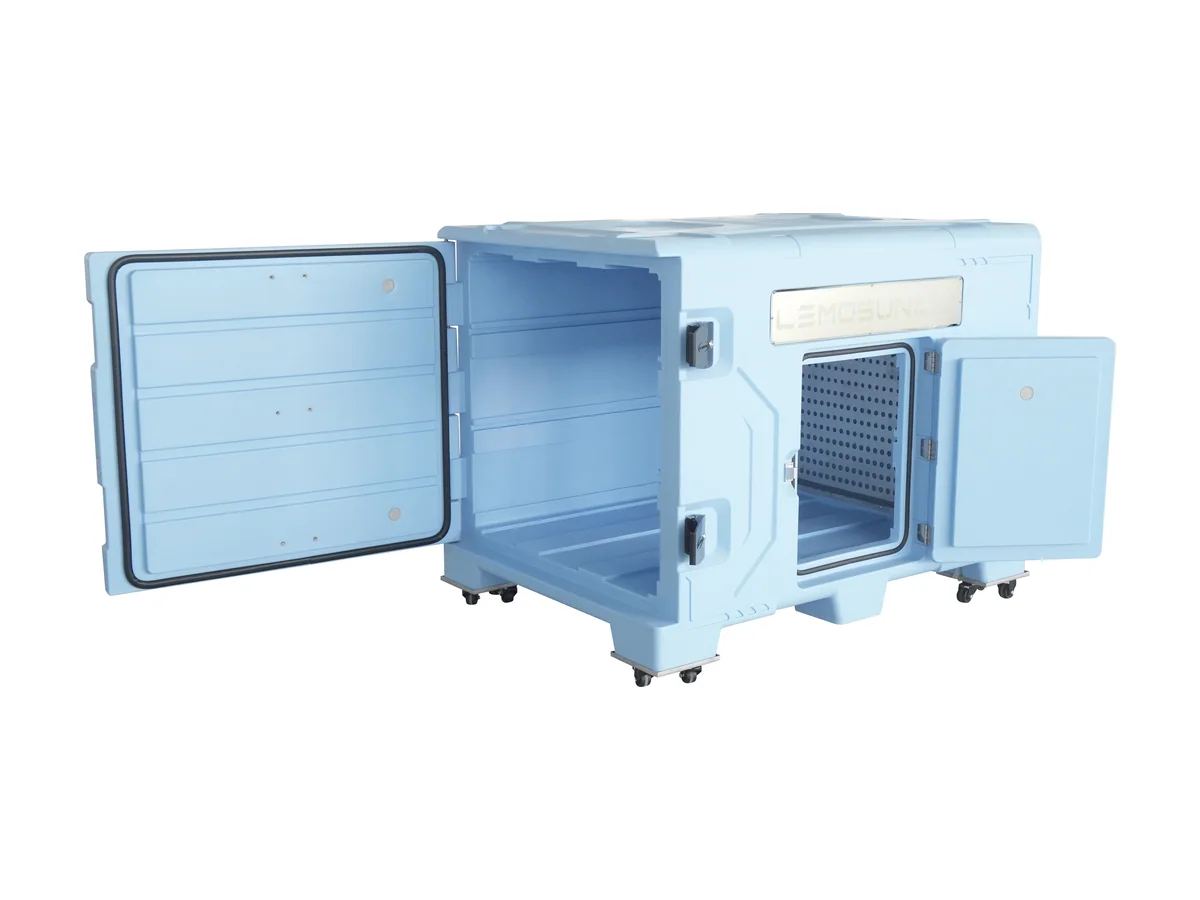
What the two versions share
Both versions have a one-piece body made by rotational molding. The outer shell and the inner liner are LLDPE, 3.5 mm thick. After molding, the shell goes into a foaming mold and polyurethane is poured into the cavity in one piece, 75 mm thick in both versions. Both load through a rear door and have a small side door for picking.
Side by side
| Standard version | Double-door version | |
|---|---|---|
| Volume | 980 L | 1000 L |
| External size (L × W × H) | 1528 × 1088 × 1128 mm, without casters | 1530 × 1110 × 1130 mm |
| Weight | 150 kg, unit included, battery excluded | 130 kg, unit included, battery excluded |
| Refrigeration unit | Front-mounted | Top-mounted |
| Foam density | 40 kg/m³, the denser of the two | 35 kg/m³ |
| Handling | Forklift pockets; stackable, because the unit sits at the front | Mounting holes and a battery cable outlet in the base |
| Ice hold without power | 18 h | 12 h |
| Pull-down, empty cabinet | +23.1 °C to −18 °C in about 43 min; −20.1 °C at 51 min | +24.3 °C to −18 °C in 41 min and to −25 °C in 65 min |
| Best suited to | Stand-alone use, moved by forklift or on casters | Electric tricycles and trailers, outdoor work |
Ice hold: 35 °C ambient, cabinet filled with 0 °C ice, timed until all the ice had melted.
Why the standard version holds cold longer
Without power, the standard version kept ice for 18 hours and the double-door version for 12 hours. Both have 75 mm of foam, but the standard version's foam is denser, 40 kg/m³ against 35 kg/m³, which the factory gives as the reason for its better insulation. If the box will spend time unplugged, for example during loading or a power cut, that difference matters.
Why the double-door version suits vehicles
The double-door version carries its refrigeration unit on top. According to the factory it cools down faster outdoors, and it is the version fitted to our electric tricycle and trailer. Its unit has a built-in converter for the tricycle's 72 V supply, and the base has mounting holes and an outlet for the battery cable. We do not recommend it for trucks; if it must go on one, the base needs a frame and wheels fitted.
Reading the internal dimensions
For neither version do the internal dimensions translate directly into volume. The standard version's liner has raised air ducts. Its clear internal size, 1130 × 910 × 880 mm, is measured between them and leaves out the recesses, so the usable 980 L is more than the clear size suggests. The double-door version's internal size, 1370 × 900 × 920 mm, includes the space taken by the refrigeration unit, so its usable 1000 L is less. If you need to fit a pallet or a crate, send us its size and we will check it.
Comparing the pull-down figures
The two pull-down figures come from different runs that started at different temperatures, +23.1 °C and +24.3 °C, so they are not a controlled comparison. Read both as "under an hour from room temperature to −18 °C, empty". The full records are on the LMS980 page and in how we test a cold chain box before it ships.
In short. Stand-alone use, long periods unplugged, forklift handling: the standard version (980 L, 18 h ice hold). On a tricycle or trailer, outdoors: the double-door version (1000 L, unit on top). Both: 75 mm polyurethane, 3.5 mm LLDPE shell and liner, rear door and side door.