
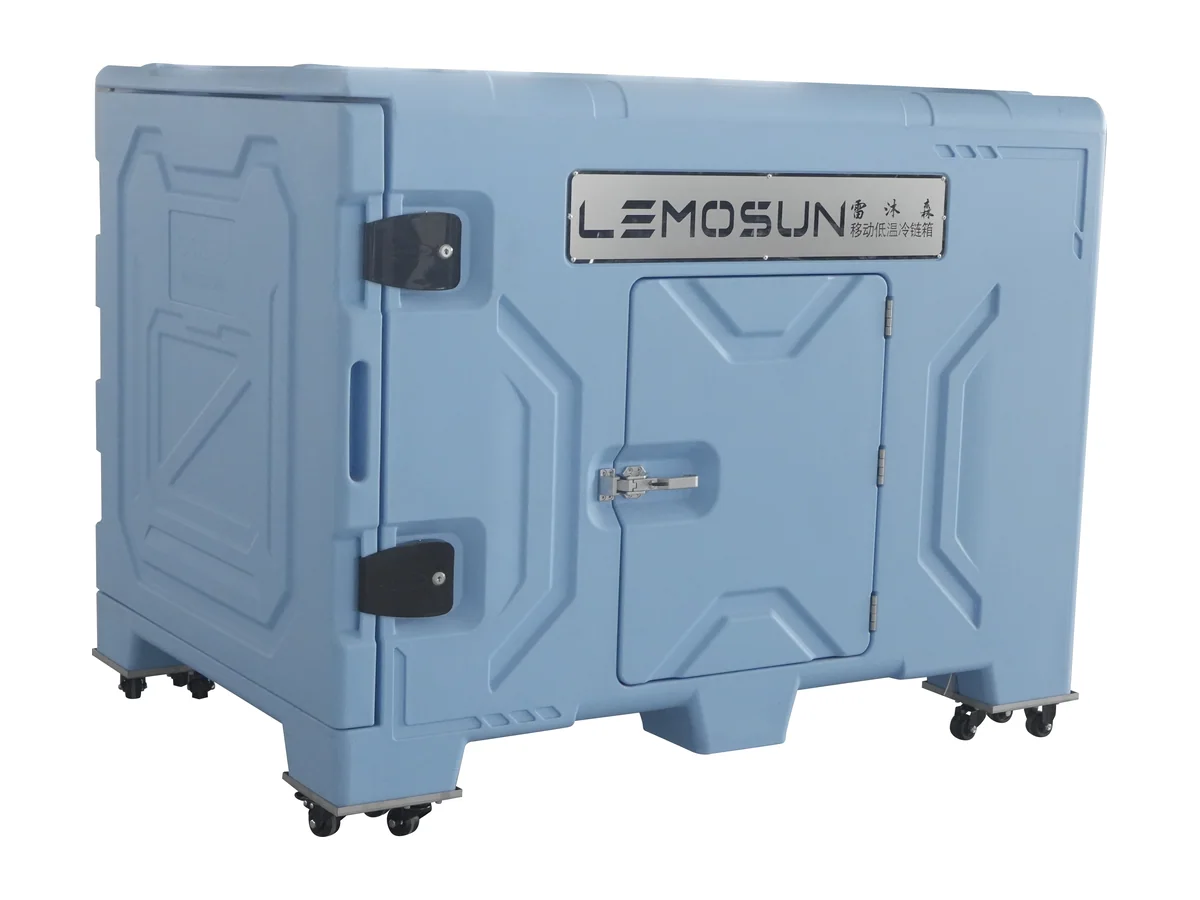
What was tested
| Item | Entry |
|---|---|
| Laboratory | SGS |
| Report number | NGBHL26009682901 |
| Report date | 30 October 2026 |
| Sample | "COLD CHAIN BOX-LMS", grey polyethylene |
| Where the material is used | Outer shell and inner liner of both LMS980 versions, rotomolded, 3.5 mm thick |
| Standard | US FDA 21 CFR 177.1520, olefin polymers |
| Conclusion | Pass |
21 CFR 177.1520 is the US Food and Drug Administration rule for polyethylene, polypropylene and other olefin polymers used in articles that come into contact with food. It defines each class of polymer, for example by density, and limits how much of the plastic can be extracted by solvents.
The three results
| Test | Requirement | Result |
|---|---|---|
| Density | 0.85–1.00 g/cm³ | 0.915 g/cm³ |
| n-hexane extractables | 5.5 % maximum | 0.2 % |
| Xylene solubles | 11.3 % maximum | 2.9 % |
What each test measures
- Density shows which class of polymer the sample belongs to, and so which limits apply.
- n-hexane extractables is the share of the plastic that dissolves in n-hexane, a solvent used as a stand-in for fatty food. 0.2 % is under a twentieth of the limit.
- Xylene solubles is the share that dissolves in xylene. 2.9 % is about a quarter of the limit.
Low values in both extraction tests mean that little of the plastic can dissolve out.
Why the material is LLDPE
A density of 0.915 g/cm³ places the material in the range of linear low-density polyethylene (LLDPE). High-density polyethylene is usually above 0.94 g/cm³. LLDPE is widely used for rotational molding because it flows well in the mold and stays tough at low temperatures, which suits a box that runs at −25 °C.
What the report does not cover
- It covers the polyethylene of the shell and liner. Door seals, latches, the refrigeration unit and other parts are not included.
- It is a US FDA test. It is not an EU food-contact migration test under Regulation (EU) No 10/2011.
- It is one sample, tested in October 2026.
- Clean the cabinet before first use and between loads, as with any food container.
Ask for the report. We send SGS report No. NGBHL26009682901 on request. It is listed with our other documents on the certifications page, and the product details are on the LMS980 page.