
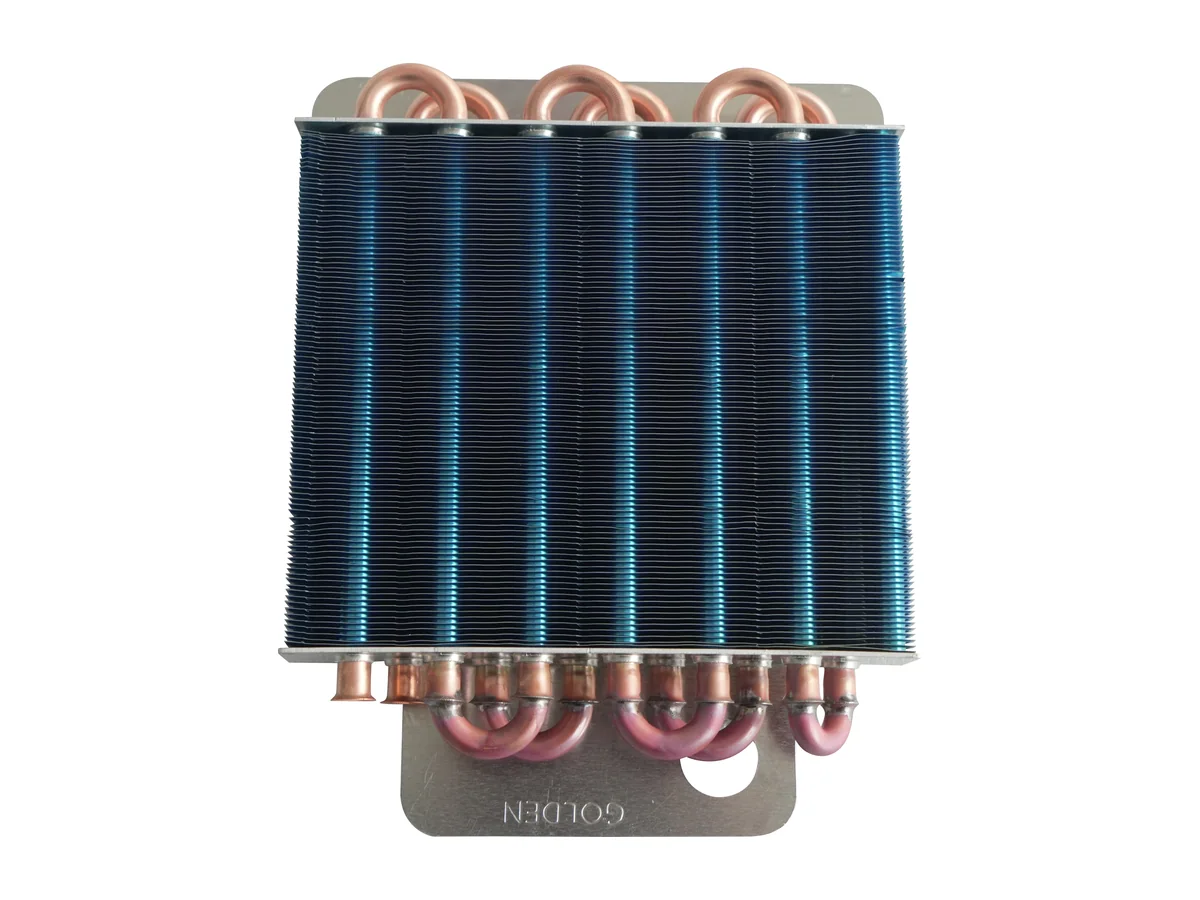
Why test every coil
A finned tube coil has dozens of brazed joints where return bends, headers and connections meet the tube. A joint can look sound and still have a pinhole. In a sealed refrigeration system even a slow leak drains the charge, the system loses capacity and someone has to find the fault on site. A test on a sample only tells you about the sample, so every coil we make goes through the same test.
Three pressures, three meanings
Coil specifications often list more than one pressure. They answer different questions:
| Term | Our figure | What it means |
|---|---|---|
| Design pressure | 4.5 MPa, refrigerant side | The pressure the coil is designed for |
| Working pressure | 3.8–4.2 MPa, set to your requirement | The pressure in normal operation of your system |
| Leak test pressure | 3.9 MPa as routine; up to 4.2 MPa on request | The nitrogen pressure each coil is tested at |
On the shop floor the test pressure is set as "40 kg", short for 40 kgf/cm², which is about 3.9 MPa. We test at 3.9 MPa because that is what our customers' specifications currently ask for. If your system runs at 4.2 MPa, or your standard calls for a higher test pressure, tell us: we can test every coil at up to 4.2 MPa.
The procedure, step by step
- Seal the coil. The coil is mounted on a test fixture that closes its open connections.
- Fill it with dry nitrogen. Nitrogen is dry and inert, so it leaves no moisture in the circuit. The coil is brought up to the test pressure.
- Check it under water. The pressurized coil goes into a water tank. A leak shows as a stream of bubbles. No bubbles means the coil passes this check.
- Hold the pressure. Coils are also kept charged with nitrogen and normally left to stand for 24 to 48 hours. A hold over a day or two is meant to reveal leaks too slow to show as bubbles.
- Repair and retest. If a coil leaks, the leak point is found and repaired, and the coil is tested again.
What the test shows, and what it does not
- It shows that the coil did not leak at the test pressure.
- It is a tightness test, not a burst or strength test. No coil is taken to failure.
- It covers the coil, not your system. Joints made during installation need their own test on site.
What to put in your specification
- The refrigerant and the maximum working pressure of your system.
- The test pressure your standard or your customer requires, if it differs from 3.9 MPa. We test at up to 4.2 MPa.
- Whether every coil must be tested. Ours are, as standard.
- The test method you expect, for example nitrogen with a water-tank bubble check and a pressure hold.
In short. Every coil · dry nitrogen at 3.9 MPa (40 kgf/cm²), up to 4.2 MPa on request · water-tank bubble check · 24–48 h pressure hold · leaks repaired and retested. Specifications are on the heat exchanger page; the production route is in how a finned tube heat exchanger is made.