
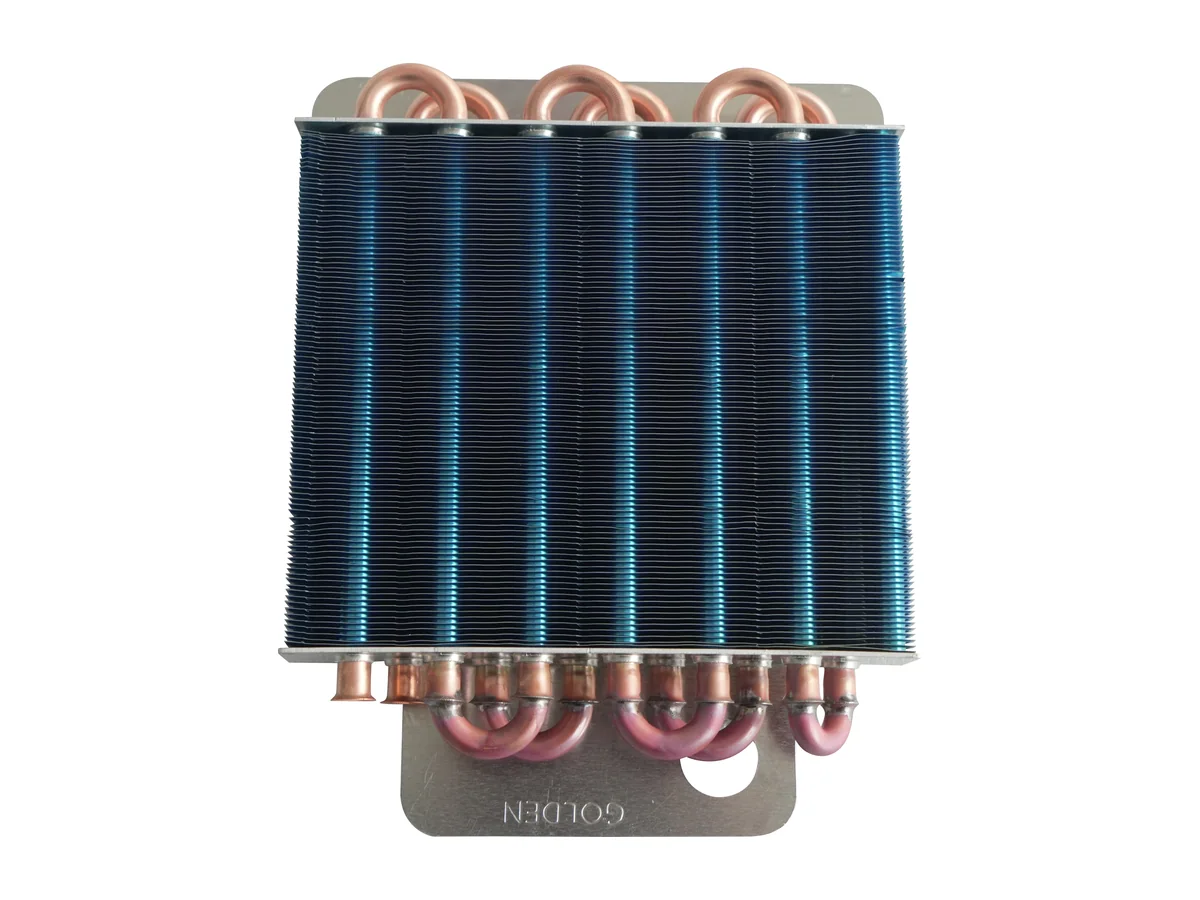
Start with the duty
If you have a drawing, send it. If you do not, the factory needs the job the coil has to do: cooling or heating capacity, refrigerant, evaporating or condensing temperature, air volume and air temperature on the way in, and the space the coil must fit into.
Tube diameter
Smaller tubes make a more compact coil and need less refrigerant, but each circuit has a higher pressure drop, so the coil needs more circuits. Larger tubes suit large capacities and long circuits. We work with 7, 7.94, 9.52, 12.7 and 15.88 mm tube.
Tube pattern
The pattern is the distance between tubes in a row (tube pitch) and between rows (row pitch). It decides which fin tooling is used, so it is the first thing to check against a factory's list. Our twelve tooled patterns are on the heat exchanger page.
Fin pitch
- Close pitch, around 1.5 to 2.5 mm, gives the most surface in a given volume. It suits air conditioning coils and condensers in clean air.
- Wide pitch, 4 to 6 mm, suits evaporators that run below freezing. Frost builds on the fins, and a wide gap takes longer to block between defrosts. Wide pitch also suits dusty air.
Fin finish
| Finish | What it does | Typical use |
|---|---|---|
| Hydrophilic | Condensate spreads into a film and drains instead of forming drops that bridge the fins | Evaporators, indoor coils |
| Bare aluminum | Lowest cost | Condensers in clean, dry air |
| Anti-corrosion coating | Protects the fin from salt and pollutants | Coastal sites, industrial air, kitchens |
Circuits and connections
The number of circuits balances heat transfer against pressure drop. If you have no circuit drawing, state the refrigerant and the capacity and let the factory propose one. Say how the coil connects to your system: threaded, brazed or V-groove, and on which side.
Testing
Ask how every coil is tested, not just a sample. At Lemosun each coil is pressurized to 3.8 MPa and checked for leaks before packing.
The short checklist. Drawing or sample · refrigerant and working pressure · capacity and air conditions · overall dimensions · tube diameter and pattern · fin pitch and finish · connection type and side · quantity.