
What density means for EPP
EPP parts are molded from expanded polypropylene beads that are fused together with steam. Density, in kg/m³, tells you how much polymer is in each cubic meter of foam. A denser grade has more material in the cell walls, so it is heavier, stiffer and better at resisting dents and compression. A lighter grade uses less material in each part.
We can mold EPP at 30, 45, 60 or 80 kg/m³. Our standard products use the two lighter grades:
| Product | Density | Thermal conductivity (λ) | Wall thickness | Heat flow per m² of wall and per K |
|---|---|---|---|---|
| EPP folding box (LMSZDBWX) | 30 kg/m³ | 0.037 W/(m·K) | 50 mm | 0.74 W/(m²·K) |
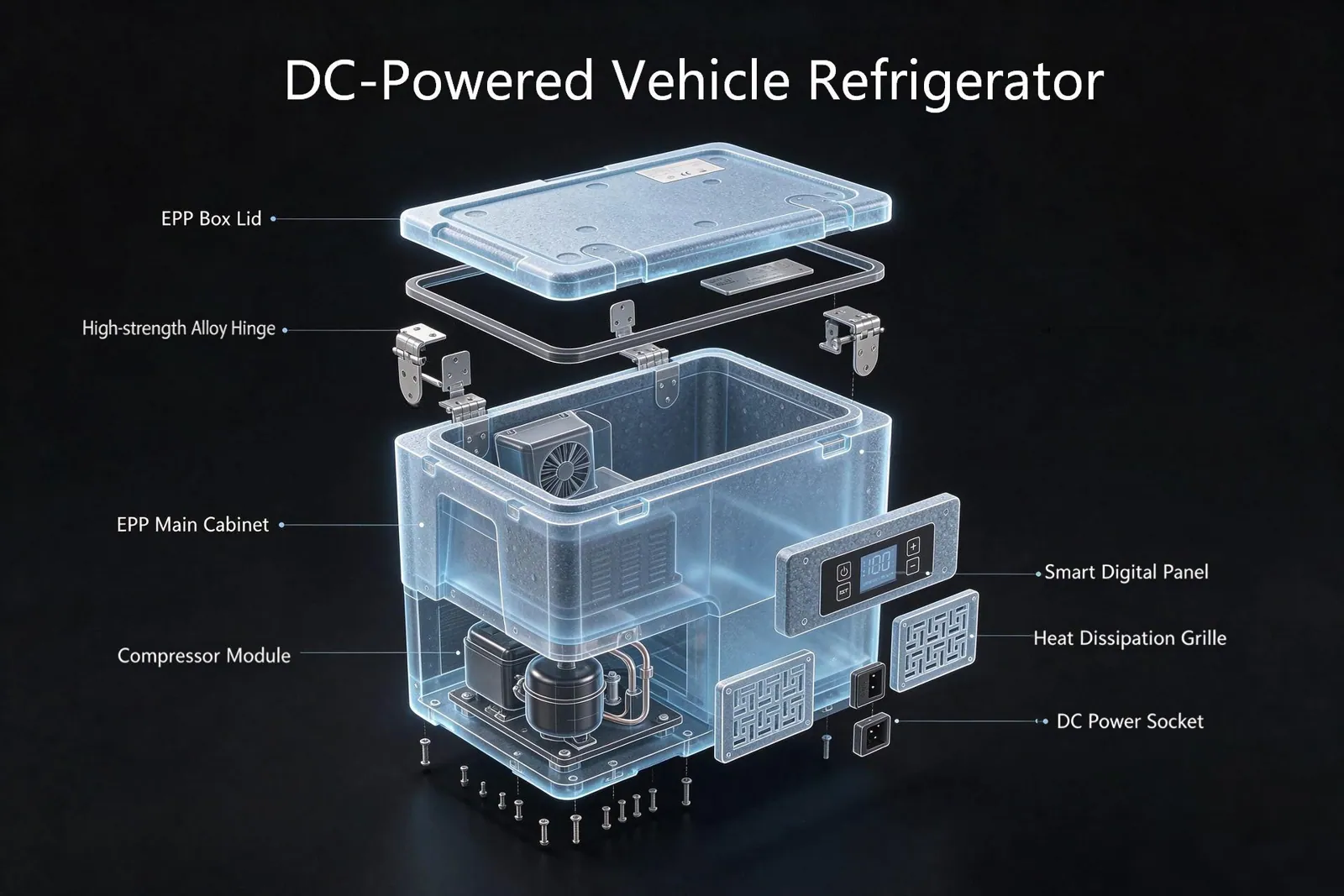
| Car fridge (LMSCZBX) | 45 kg/m³ | 0.038 W/(m·K) | 35 mm | 1.09 W/(m²·K) |
The last column is λ divided by wall thickness: the heat conducted through one square meter of flat wall for each kelvin of temperature difference. It ignores corners, lids and seals, so use it to compare walls, not to predict a hold time.
Density changes the insulation very little
Thermal conductivity, λ, is the property that sets how much heat passes through the foam. Across the grades we use it runs from 0.035 to 0.045 W/(m·K). Between our 30 and 45 kg/m³ grades it differs by only 0.001 W/(m·K). The bigger lever is thickness. The folding box wall is 50 mm and the car fridge wall 35 mm, so the folding box wall lets about a third less heat through each square meter, even though its foam is lighter.
Choosing a grade
- 30 kg/m³ for light, reusable boxes that are carried by hand and folded for the return trip. Weight counts on every trip.
- 45 kg/m³ where the body must be stiffer, as in our car fridges, whose cabinet also carries the compressor module. Car fridges are made at 45 kg/m³ as standard; another density can be molded on request.
- 60 or 80 kg/m³ for parts that must take heavier loads or knocks. Tell us the load and we will suggest a grade.
How long an EPP box lasts
EPP bends and recovers where EPS foam cracks, which is why it is used for boxes that go round again and again. Our factory figure is about 200 reuse cycles in normal use; under rough handling, boxes have gone through 30 to 40 cycles without problems. Wear depends on handling, stacking and cleaning, so treat these figures as a guide. EPP is used from −40 °C to +110 °C.
What to ask an EPP box supplier
- The density in kg/m³, and the thermal conductivity of that grade.
- The wall thickness, which matters more for insulation than density.
- How many reuse cycles they expect, and under what handling.
- A chemical test on the material. Ours is explained in Is EPP safe?
In short. Folding boxes: 30 kg/m³, λ 0.037, 50 mm walls · car fridges: 45 kg/m³, λ 0.038, 35 mm walls · 60 and 80 kg/m³ to order · about 200 reuse cycles · −40 °C to +110 °C. See the EPP folding boxes and the car fridges.